Blog

05 Oct
ACQ Magazine Awards LockeBridge Leading Boutique Investment Bank of the Year

London, October 2014

ACQ, a premier U.K. based global M&A magazine, is proud to release the results of its ACQ Global Awards 2014  taking the ultimate step in the search for the most outstanding company, practice area, individual and firm-wide professionals within the public & private sectors across the globe. All the awards have one central theme – they recognize institutions and individuals that demonstrate leadership, innovation and momentum in the markets in which they excel.

                          We congratulate LockeBridge, LLC for winning

                     THE USA LEADING INVESTMENT BANK OF THE YEAR

The ACQ Global Awards have been celebrating achievement, innovation and brilliance in their annual awards since 2003. This year the total number of nominations received stood at an amazing 28,246.  In judging these awards we have studied the nominations made by our voters and recognize that all those nominated are leaders in their fields but the exception performance of some deserve recognition. The quality of this year’s entries is astonishingly high and a testament tot he fact that the profession continues to innovate and deliver high-quality services even in economically challenging times.

Exceptional individuals, teams and firms across the marketplace represent the very best in their field from around the world and truly deserve the accolade of being an ACQ Award winner.  All category winners are in effect, a brand.  In one sense, perhaps the most important sense, a brand is a promise. You know what you’re going to get with a well-branded product or service. It takes a lot of time, money and very hard work to build and maintain great brands, brands that can speak volumes in just a few syllables. It’s shorthand for what you are.”

Jake Robson

Editor in Chief

AQC Magazine

The LockeBridge Award  can be viewed on page 51 in the AQC Global Awards Publication.  The Award will also be advertised on CNN and The London Financial Times website.

Jake Robson
Editor in Chief
AQC Magazine

The LockeBridge Award can be viewed on page 63 in the AQC Global Awards Publication or by clicking here. The Award will also be advertised on CNN and The London Financial Times website.

01 Mar
Negotiating a Premium for the Sale of Your Business

Negotiating a Premium for the Sale of Your Business can take substantial preparation well beyond practicing your presentation. Most Buyers are significantly larger then the Seller, have executed numerous deals and have a team that is well coordinated and trained in all relevant areas of merger and acquisitions. Knowing that most Sellers of small businesses have never sold a business before you can be easy prey for the Buyer if you are not well prepared.

The key to achieving a premium for the sale of your business is not necessarily your ability to make a credible presentation of the valuable assets and opportunities in your business, which are rarely presented in an optimal fashion. When selling your business to a strategic buyer the most critical aspect of the negotiation is dependent upon your understanding of the Buyer’s operations and the determination of the value of the synergies which would be created by the merge of the two companies. Most people relate to the term 1+1=3. What is implied by this term is that the sum of the parts, when combined together, exceeds the total of the individual components when they remain separate. The amount by which the former exceeds the latter is referred to as the value of the synergies.

Synergies can come from either or both the cost side or revenue side of the equation. On the cost side, the consolidation of the operations generally presents a significant opportunity to cut costs. Examples of typical cost cutting are: Closing of duplicative locations, elimination of redundant jobs, an increase in buying power and reduction of part numbers. On the revenue side there may be an opportunity to raise prices or sell more product due to cross selling opportunities, reduced competitive pricing pressure and increased brand marketing.

The general rule of thumb is that the greater the amount of synergies the more the value and the more the Buyer can afford to pay. However, extracting the value of those synergies is quite another story. The savvy Buyer will never disclose the source of the synergies, let alone the value of such synergies. So how are you, the Seller, going to estimate the value of such synergies, which is the first step in executing a negotiating strategy which will reflect the value of the synergies in the price of your business.

As seen in the illustration below, the Normalized or Recasted EBITDA (i.e. adjusted for such items as owner’s excesses and one time events) of the Seller’s business is $2,000,000. Applying a 4X EBITDA multiple, a typical multiple for small businesses with little to no growth which are purchased by financial buyers, yields a price of $8 million. On the other hand, Strategic Buyers often pay multiples of 5 to 8 times EBITDA, depending on the magnitude of the synergies. Because of the synergies, the Strategic Buyer can justify paying a much higher price while still achieving their required return on equity (ROE). Let’s be clear, the required ROE for the Strategic Buyer is the exact same as that of the Financial Buyer. The only difference is that the Strategic Buyer, because of the value of the synergies, can afford to pay a higher price while still achieving the required ROE. Of course just because he can afford to pay a higher price does not mean that you, the Seller, will be able to negotiate such a premium price for your company.

Let’s look at an example. In our example, the synergies which can come from various areas such as cost savings, increase in sales from cross selling, technology benefits, etc., are estimated to be $1.0 million, which results in an adjusted “Synergistic EBITDA” of $3.0 million. Applying the same 4X multiple now results in a value to the Strategic Buyer of $12 million, the “Synergistic Value”, a 50% premium over the “Financial Value” of $8 million. Your ability to get the entire value of the synergies depends upon your negotiating skills. Chances are that the Negotiated Price will end up somewhere between the Financial Value and Synergistic Value. Your ability to negotiate a premium for the sale of you business will depend on several factors including your confidence in the estimated synergistic value.


Financial Buyer

Value of Synergies N/A
Normalized EBITDA $2,000K
Mutliple 4.0X
Financial Value $8,000
Buyer’s Initial Offer $7,000
Negotiated Price $8,000K
(+/- 10%)

Strategic Buyer

Value of Synergies $1,000K
Normalized EBITDA $3,000K
Mutliple 4.0X
Synergistic Value 12,000K
Buyer’s Initial Offer $7,000K
Negotiated Price $10,000K
(+/- 20%)

So how are you, the Seller, going to determine the value of the synergies and once determined how are you going to extract the entire Synergistic Value of $12 million, $4 million more than the Financial Value? As stated in the prior article, Selling Your Business to a Multi- Billion Dollar Acquirer, the prudent Buyer will not disclose the nature of their anticipated synergies to the Seller. The Buyer’s mentality is that they are enabling the resultant increase in value. As such, it is their objective to keep all of the incremental value emanating from those synergies. In the next articles we will explore how to obtain a premium price for your business by extracting the value of the synergies.

01 Dec
Selling Your Business to a Strategic Buyer

When selling your business to a strategic buyer, a principal objective should be to identify the incremental value of the synergies created by the merge of the two entities and capture as much of that value as possible. The first step in extracting the value of the synergies is to estimate the dollar amount of value created from the synergies. As stated in the last article, synergies can come from various places such as Cost & Risk Reductions, Process Improvements, Revenue Augmentation and Economies of Scale. According to The Boston Consulting Group, 94 percent of merger announcements which disclose the value of synergies mention only cost synergies or don’t mention the specific nature of the synergies at all. 1 The principal reason for the foregoing is that cost based synergies are the easiest to quantify. For example, estimating savings from eliminating administrative redundancy, consolidating operations and increased purchasing power are relatively straight forward.

With the above stated, bolt-on acquisitions completed by larger companies often result in substantial revenue synergies. Many larger companies acquire smaller “bolt-on” companies in order to add complimentary products to their offerings, which their sales people sell to the existing customer base. Furthermore, cross selling opportunities, the potential to sell both company’s products to the other company, can materially increase the Buyer’s revenue.

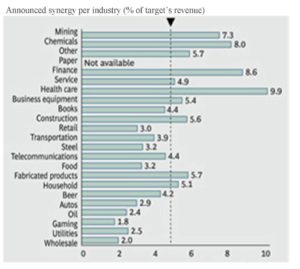
According to a 2012 study performed by Thompson Reuters, transaction synergies from a sample of 365 deals with values of more than $300 million that took place from 2000 – 2011 range from 2 to 10 percent (depending on the industry) of the target company’s latest annual sales, with a median of 4.8 percent (refer to chart below). If we assume that a similar level of synergies exist with lower mid-market transactions (i.e. transaction values less than $100M) we can infer that the synergies contribute an additional 50% or so to a typical small company’s EBITDA.2 But what if the Buyer generates billions of dollars of revenues in your market. Simply dropping your products into the hands of their salespeople can result in increasing your Company’s sales by a magnitude!

Source: Thomson Reuters Data Stream

Another statistic of the aforementioned Thomas Reuters study is the median amount of synergies captured by the selling company and reflected in the transaction price is 31%. When we multiply this 31% by the approximate 50% of incremental value created by the synergies, we can estimate that the average amount of transaction premium captured by Sellers from synergies is approximately 15%. This infers that a 5X EBITDA mutiple (a typical small company multiple paid for companies which have an anticipated 10% CAGR) would increase to 5.75X when sold to a strategic buyer with average synergies. It is important to note that the 31% statistic is based upon transactions values in excess of $300 million. Sellers of such transactions generally employ seasoned transaction advisory professionals where Sellers of lower mid-market (< $50M) transactions, and especially those executing transaction less than $20M generally do not have such transaction expertise.

Accordingly, it is our observation that most Sellers of smaller transactions (< $20M) see little to no increase in value due to synergies resulting from a sale to a strategic buyer. From our perspective, this is unacceptable.

There are a magnitude more potential financial buyers then strategic buyers, so why search for a strategic buyer if the Seller is not going to benefit from the synergies! In fact, the 31% of the total synergies which are captured by the Seller is also unacceptable to us. By effectively preparing the company for a transaction, studying the Buyer’s operations to enable a reasonable estimate of the value of the potential synergies and by applying seasoned negotiating skills one should be able to grab much more than the reported 31% of the synergistic value.

Don’t settle for little to no share of the synergies, let alone the average 31%. Sign up to receive the LockeBridge Newsletter to get the next articles in which we will discuss, how you (the Seller) can grab more than your fair share of the synergies created.

  1. March 27, 2013; Jens Kengelbach, Dennis Utzerath, Christoph Kaserer, and Sebastian Schatt; How Successful M&A Deals Split the Synergies.
  2. Assumes that a typical EBITDA margin of a well run company is 10%.
01 Jun
When Should I Sell My Business?

While working with business owners one of the issues most often pondered is “When Should I Sell My Business?” On a personal level the answer may be:

  • when your heart is no longer into it
  • when you decide it will take new blood or capital to get to the next level
  • when you reach an age when you are ready to retire
  • or any of a host of personal reasons

While any of the above may be good answers, one principal objective of the investment banker should be to help business owners time an exit so as to maximize their value in a transaction. Since the last recession officially ended in June 2009, we are now talking to many business owners who have two or three years of double digit earnings growth. Many of these people are baby boomers thinking about an exit strategy and believe their business has at least one more year of solid growth. They also do not want to get stuck fighting their way through another downturn. So, the real question is:

“Do I sell today or bet on another year of growth?”

The short answer is that buyer expectations drive value and one slow year deflates expectations very quickly. Buyers are investing in expected future earnings and historical earnings and growth rates are the baseline for creating the expectations. Discounted Cash Flow (“DCF”) valuation models are the tool most frequently used to quantify future value. The following example illustrates the importance of selling when expectations are high.

Assumptions – Company for Sale:

  1. Revenues and earnings have been growing by 10% annually, outlook is good.
  2. A buyer can borrow 30% of the purchase price based on the company’s cash flow and balance sheet. Weighted average cost of capital is approximately 16.8%.
  3. The fiscal year just completed produced operating income of $1,000,000.

Scenario 1 – Sell Today

  1. Buyer’s DCF model assumes growth will continue at 10% for the next 5 years and then 5% in perpetuity.
  2. The discounted cash flow valuation is $6.2 M.

Scenario 2 – Grow for 1 more year, then sell

  1. The economy slows and operating income grows by 5% to $1,050,000.
  2. Buyer’s DCF model assumes growth continues at 5% for 5 years and then 3% in perpetuity.

The discounted cash flow valuation is $4.9 M.

Conclusion

Selling with a strong growth outlook (scenario 1), versus selling later with a larger profit but a weaker growth outlook (scenario 2), almost always results in a higher transaction value. In the example, the Seller would have achieved a $1.3M higher valuation had he sold today with $1.0M of profit and growth rates of 10% (scenario 1), versus selling a year later with the higher profit of $1.05M but a lower growth rate of 5%. (scenario 2).

Both scenarios involve buyers with reasonable expectations based on recent operating histories, but higher earnings are almost never an adequate substitute for faster and/or more predictable sustainable growth.

There are many factors that are considered when a buyer values a company. Return on investment as quantified in a Discounted Cash Flow analysis, which discounts future expected earnings, is often a major consideration. That stated, our answer to the question of “when to sell,” is the following:

Sell when you have strong growth. Do not underestimate the risks of trying to add another dollar of profit. If you sincerely believe that there will be strong growth for a few more years, negotiate an earn-out or retain some equity so that you can participate in the upside, after you have put some money in the bank and mitigated the potential risk of a slow down.

As a final consideration, we like to remind clients to plan on one to three years from the time you decide to sell until the time you are free to sit on a beach. This includes six to 12 months to complete a transaction and one to three years for a typical employment transition and/or earn-out.

Note: There are many factors that are considered when an investment banker or a prospective buyer estimates the value of a company. Discounted cash flow models are a frequently used tool and involve more variables than could be reasonably factored into the above illustration. Buyers who are seeking to satisfy strategic objectives through an acquisition will frequently offer valuations that are above what could be justified by DCF modeling. Only the market can determine what a company is truly worth.

01 Jun
Engaging an Investment Banker: What You Should Know

In the prior article titled Investment Banking Retainer Fees – Beware of Conflicts I mentioned that the average closing rate among US intermediaries representing transactions valued in the range of $5 million to $30 million range is approximately 30%. I also stated that the average engagement fee for such transactions is around $50 thousand. Needless to say, I never met a business owner who wanted to pay an engagement fee or retainer, especially with a success rate of only 30%. So what are you going to do about this issue when it is time to sell your business? My suggestion when choosing an investment banker is as follows:

  1. Be sure to get a valuation from the prospective banker prior to engaging. Make sure that the Banker justifies the valuation to you with high credibility.
  2. Some bankers may try to charge you for the valuation. In my opinion, this is an investment that the banker needs to make in order to “quote the job”. Would you pay a builder to quote you price to build a home, or a real estate agent to give you an estimate on the value of your house?
  3. Ask the banker what he/she thinks is the probability of closing the transaction at the valuation provided.
  4. Don’t even consider selling your Company if the probability is less the 70% – 80%. There’s just too much work and exposure risk to enter into this arduous process for any less than a 70% probability of success.
  5. Assuming that the banker is quite confident of meeting your objective then ask him/her “If you are so confident of selling my company, why then do you need a retainer?”

Several common answers to this question are:

  1. Because it typically takes 6 – 12 months to sell a company and in the meantime we have significant overhead.
  2. Because we need to know you’re serious before we invest our substantial resources to sell your company.

My thought on these answers are as follows:

  1. I would not want to engage with an advisor that is going to assist me to sell one of the largest, if not the largest, transaction of my life if that advisor needed my retainer to pay his overhead.
  2. If the advisor cannot tell if you, the Prospective Seller, is serious then how on earth will he/she be able to determine if the potential buyer is serious? After stating the foregoing to the advisor perhaps he responds with; “With no skin in the game what is stopping you from just changing your mind after we expend a substantial amount of our resources to sell your Company?” There are many ways to deal with this, such as the implementation of a break fee in the event that the advisor brings bonafide offers which meet some predetermined criteria. The advisor is supposedly an expert in deal structuring, surely he can structure a deal with you that will meet both of your needs!

OK, down to brass tacks. The above is all well and good but the fact of the matter is that most advisors in the lower middle market just cannot afford to do enough diligence to provide them with the confidence they need to waive the retainer. Let’s, for a moment, put aside the potential conflicts of interest that a large engagement fee can cause. If the advisor does not have confidence that they will succeed, at least a 70% confidence level as previously stated, then I don’t believe that the business owner should hire such advisor. The worst thing that can possibly happen is that you execute the selling process more than once. This is one process that you want to do the right way the first time. The implications of going to market a second time can be disastrous, but this is a topic for another article.

With the above stated, if you find that you cannot avoid paying the retainer and still want to engage the Advisor, at least you should have gotten a warm and cozy from the answers the Advisor provided to the above questions. I think you will be surprised by the type of answers you get. The worst that happens, as a result of these questions, is that you will learn allot about the thinking of the advisors which may represent one of the most important transactions of your life.

01 Mar
Investment Banking Retainer Fees – Beware of Conflicts

The investment banking industry refers to a retainer as a fee paid up front which is generally credited against a success fee, but foregone if a transaction is not consummated. A more appropriate term for such an upfront fee would be an engagement fee, not to be confused with a retainer which is only used to pay out of pocket expenses. The typical engagement fees for lower mid-market sell side transactions ranging in size from $5 million to $50 million is $25 thousand to $100 thousand. At a $10 million transaction size the common engagement fee is $50 thousand. The fee can be paid all upfront or in monthly installments or a combination, such as $25 thousand upon engagement and $5 thousand per month starting in month 4.

In general I don’t have a problem with engagement fees charged on larger deals in which the transaction size exceeds $25 million or so. The issue I have with engagement fees on smaller deals is that the vast majority of intermediaries which execute smaller deals have relatively low overhead, as such these firms often make a living from the engagement fee itself. This is often the source of numerous potential conflicts.

Conflict #1

Bias Toward Overvaluing the Business

How do you think a real estate agent might persuade you to engage them to sell your house? Their number one tactic would most likely be to convince you that they can fetch a higher price then the next guy. They might tell you that they can get $1 million, for example, when they know that the value of the house is really in the range of $900 thousand to $950 thousand. You then execute a six month exclusive agreement, and now they own you. The agent then brings multiple offers that are all in the $900 thousand to $950 thousand range and gives you all sorts of reasons why you house is not fetching the $1 million price tag. In broker lingo, they call this “bringing you to school”. The broker knows that if you are motivated to sell you will eventually lower your price to meet the market’s valuation. So, the broker misled you in order to convince you to hire him, and he was not even asking for any upfront fee. Now imagine how he might mislead you if he were asking for a $50 thousand upfront engagement fee!

Conflict #2

Accepting Low Probability Engagements

According to a information published by the International Business Brokers Association, the average closing rate among US intermediaries representing transactions valued in the range of $10 million is approximately 30%. This just does not make any sense to me. Why would someone pay a $50 thousand engagement fee for a 30% chance of success? Not to mention that there is generally significant work required by the Owner in any exit process, as well as a risk of a confidentiality breach which can harm the business. Wouldn’t one just be better off to put their $50 thousand on red at the roulette table! When the business broker or investment banker can make a living from the engagement fee it’s not hard to imagine that they may not be very selective. Our experience at LockeBridge, a registered Boston based Investment Banker, is that about half of the businesses for sale are not saleable; with the reason often being that the typical sell-side broker will take any engagement in which they can earn a $50 thousand upfront fee.

In addition to the above, large upfront fees can also result in several other potential conflicts such as a low commitment to success and low investment in resources devoted to the engagement. So what’s the alternative? Unfortunately the de facto standard among seasoned investment bankers is to charge a significant engagement fee. Contrary to the legal profession, which has been around for thousands of years, mid-market investment banking has only been around in any formal way for less than 50 years, and the demand for seasoned, unbiased representation has simply not been met with an adequate supply of investment banking services in the lower end of the mid-market. In fact, at the sub $20 million transaction size it is difficult to find truly seasoned expertise even if you are willing to pay a hefty upfront fee. If one is seeking both seasoned expertise and an engagement agreement without potential built-in conflicts (i.e. no substantial upfront fee) then be prepared to look for a long time. In our experience the combination of high expertise and no engagement fee in the lower end of the mid-market is practically non-existent. This situation is not an issue in the legal profession, which seems to have worked out the demand and supply gaps over the last thousand years. In the legal profession, everyone knows that the standard contingent agreement, with no upfront engagement fee, is accompanied by a success fee of 30%. Hopefully it won’t take hundreds of years to meet the demand for high level, uncompromising mid-market investment banking representation.

01 Jan
“C” Corporation Costs

BY SCOTT WAXLER
Managing Partner, LockeBridge, LLC

During the first or second meeting with a perspective Seller we are invariably asked what the proceeds from the sale of their business will be after taxes and transaction expenses (LockeBridge specializes in selling businesses and real estate with valuations between $5M – $100M). A relatively high percentage of our perspective clients are incorporated as “C” Corporations. Most of these businesses were incorporated 20 – 30 years ago when LLC’s did not exist or were not popular (LLCs’ came into existence in 1977) and subchapter S corporations had other disadvantages at that time. For most of these companies current “C” corporation benefits, such as the right to have foreign shareholders or the ability to carry large amounts of revenue from one year to the next without negative tax implications, are not relevant or substantial.

When it comes time to sell the business, most small company “C” corporations will pay the “Tax Man” dearly.

That’s because “C” Corporations and their shareholders are subject to a double tax. Both the corporation and the shareholders are taxed. Upon the sale of assets this two tiered tax is levied on the increased value of the property when the property is sold or the corporation is liquidated. By contrast, LLC owners (called members) and Subchapter S Corporations avoid this double taxation because the business’s tax liabilities are passed through to the owners; the LLC or S Corporation itself does not pay a tax on its income.

While many tax advisors believe that a “C” Corporation Shareholder can sell stock and not incur corporate level tax on the transaction, in reality most businesses will not acquire the stock of a small corporation.

Corporate Purchasers seek to acquire the assets of the corporation because of two primary reasons:

  1. The Purchaser of the corporate assets (as opposed to stock) receives a new, stepped up, basis in the assets of the corporation equal to the purchase price. This stepped up basis can be very valuable when offsetting future gains.
  2. The liabilities of the corporation will stay with the current entity and not transfer to the Purchaser.

Issue #1 can often be overcome by adjusting the purchase price to reflect this benefit to the buyer however, issue #2 is often a showstopper impeding the sale of corporate stock. For example, imagine that the Seller is a $20 million manufacturer of snow skis which is valued at $10 million and the Acquirer has revenues of $200 million. Although a well structured stock transaction may result in total tax savings of 50% over a sale of assets, in this example these savings may only be on the order of $2 million. After considering the economic loss of the stepped up basis and some split of the tax savings between Purchaser and Seller, chances are that the Purchaser will only realize a minimal amount of net savings on the stock transaction. Let’s use a net savings of five hundred thousand dollars for this example:

It is Critical to Know Exactly Why Your Business is a “C” Corporation

The major issue for the Purchaser to consider will be:

Is it worth a savings of five hundred thousand dollars to expose their $200 million business to all the potential liabilities of the target acquisition?

Imagine that the ski manufacturer made a defective binding a year prior to the acquisition? Subsequent to the acquisition the binding failed and the skier fell and seriously injured himself. The Purchaser will be liable for the damages!

Product and environmental liabilities are two of the most concerning issues to potential Purchasers of corporate stock.

While a strong intermediary may be able to overcome such liability issues and subsequently structure a sale of corporate stock that will work for both parties, corporations should review the current pros and cons of the “C” corporation status and consider converting to an LLC or S corporation well in advance of the sale of the business. If converting to an S corporation is not possible, don’t lose sleep yet. It may be possible to structure a transaction that will allocate the purchase price so not to be exposed to double taxation. For example, professional service businesses may be able to allocate a substantial portion of the price to personal goodwill, which bypasses the corporate level tax. Additionally, retainers and non-compete agreements may be negotiated which will also bypass the corporate tax.

It is critically important to hire a strong transaction team (accountant, attorney and intermediary) that has substantial negotiation and structuring experience. When it comes to selling a “C” corporation the transaction can become much more complex and the team’s structuring tactics even more crucial. An effective deal structure will maximize the amount the Seller will have to show for a lifetime of sweat equity. Note: A strong intermediary will advise you on required skill se of the team members and coordinate the team member’s activities.

Conversion from a Subchapter S to a “C” corporation is not a problem from a tax perspective. However, going from a “C” corporation to an S can be a taxable event if the value of the corporation has appreciated since its formation. Note that generally, you cannot convert a corporation to an LLC. You will need to dissolve your corporation. Once having done this, generally one may form a new LLC using the same name.

When an existing “C” corporation converts to an S corporation, only the post-conversion appreciation in the corporation’s assets will qualify for single level tax treatment, unless the corporation’s assets are sold more than 10 years after the date of conversion. This 10-year “look back” period prevents a “C” corporation with appreciated assets (and subject to double taxation on the sale of those assets and subsequent distribution of proceeds to its shareholders) from converting to an S corporation in order to achieve a single level of taxation.

Conclusion:

If your company is a “C” corporation seriously consider a conversion that will lower the taxable impact on your business. If you plan to sell the business prior to ten years from the time of conversion then hire a strong team that will be able to assist in structuring a tax efficient transaction.

The reproduction of the information herein is prohibited without the express written consent of LockeBridge, LLC. Requests to reprint LockeBridge, LLC published material should be in written form and should specifically state the item(s) to be reprinted, the purpose and the distribution of the reprints.

05 Dec
LockeBridge Nominated for Executing the M&A Deal of the Year

December 2011

For the third time in the last 4 years LockeBridge Investment Banking has been nominated for executing the M&A “Deal of the Year” by a prestigous panel of judges working on behalf of the M&A Advisor. After winning both the “Deal Maker of the Year” and the “Consumer Services Transaction of the Year” LockeBridge again is keeping good company with many of the nation’s best of the best investment banking firms. Recognized as the Academy Awards of the Investment Banking Industry, the annual M&A Advisors’ Awards attracts the most prestigous invesment bankers, lawyers and accounting firms which participate in advising transactions from $10M to $1B in size.

               In a letter to LockeBridge the M&A Advisor wrote:
“It is my honor to  inform you that, for its superior execution of the Recapitalization of Something Sweet, Inc.,  LockeBridge will be recognized among a distinguished group of finalists.  The firm has been nominated for two awards:”


The Deal of the Year
&
The Consumer and Retail Products  Deal of the Year
According to Mr. Scott Waxler, LockeBridge Managing Partner: “The LockeBridge model of offering extraordinary expertise to lower middle market companies, a sector which generally cannot access such expertise, without requiring any engagement fees or retainers is quite unusual. The LockeBridge success rate is greater then two times higher than the industry’s average. This high success rate enables LockeBridge to forgo all engagement fees and retainers.  It’s a business model that is difficult to execute but has proven to be quite successful for us and our clients.”
About LockeBridge
LockeBridge is a Boston based investment banking advisory firm offering seasoned domestic and international expertise to owners of middle market companies. Our successful transaction experience includes expert representation in the sale, merger and acquisition of businesses to and for strategic buyers, financial partners, private investment groups, and publicly traded companies from around the world.CONTACT
LockeBridge, LLC
(781) 676-2001
marketing@lockebridge.com
29 May
LockeBridge Advises MetaSoftware on Capital Financing

For Immediate Release

LockeBridge Investment Banking announced today that it has acted as exclusive financial advisor to MetaSoftware, Inc. in securing a complex financing line as an alternative to a standard revolving credit line for the business. Based in Massachusetts, MetaSoftware, Inc., is a leading provider of Enterprise Capacity Planning & Workforce Optimization Software to major banking institutions in North America.
According to Mr. Bob Seltzer, CEO of MetaSoftware, Inc, “During the banking crisis over the last few years the Company had extended payment terms through multi-year license agreements to several global banking organizations. While we pride ourselves in our flexibility in how we structure our business terms to assist our clients, our growth requires that we in turn have access to credit.  Like many small business, during 2009 and 2010 we found, to our dismay, that conventional financing lines were largely unavailable. We were very fortunate to engage Lockebridge who, despite insurmountable odds, secured the desired financing in a matter of weeks. LockeBridge’s deep industry contacts, creative financial engineering and strategic advice has been invaluable to us and is greatly appreciated.”
Mr. Scott Waxler, Managing Partner of Lockebridge states, “Accomplishing MetaSoftware’s objectives during  the height of one of the tightest global debt markets was certainly a challenge.  We are proud to have assisted MetaSoftware, as well as numerous other companies, increase their liquidity during a critical time in their operations.”

CONTACT
LockeBridge, LLC
(781)676-2001
info@lockebridge.com

16 Dec
LockeBridge Wins “Consumer Services Deal of the Year”.

12/16/2008

FOX Business Network Anchors, Jenna Lee and Brian Sullivan presented the award for “Consumer Services M&A Deal of the Year” to LockeBridge for their participation as exclusive investment bankers in the sale of Veterans Transportation Services.

Recognized as the Academy Awards of the Investment Banking Industry, on December 15th The M&A Advisor named the winners of the prestigious M&A Advisors’ awards. Held at the historic Hudson Theatre on Broadway, over 200 firms were in attendance.

After winning the coveted “Deal Maker of the Year” award in 2006 and being nominated as a finalist for 5 additional awards since then, the unique LockeBridge business model has repeatedly been validated as offering extremely advantageous benefits to owners operating companies in the middle market. The LockeBridge Model of offering extraordinary expertise to lower middle market companies, a sector which generally cannot access such high end expertise, without requiring any engagement fees or retainers is quite unusual. The completion of the Veterans Transportation deal, led by Mr. Tyler Block, was exemplary of the seasoned advisory services provided to all LockeBridge clients.

According to Mr. Scott Waxler, LockeBridge Managing Partner: “The LockeBridge success rate is approximately three times higher than the industry’s average. This high success rate enables LockeBridge to assume the financial risk of bringing the Client to market through our no engagement fee or retainer policy. With this policy the objective of the client and those of LockeBridge are completely aligned. It’s a business model that is difficult to execute but has proven to be quite successful for us. In fact, I don’t know of any other firm in the country that offers top tier advisory services to the middle market while not charging any retainer fees.”

According to Roger Aguinaldo, CEO and Publisher of The M&A Advisor, “The response to our call for nominations this year was overwhelming. Considering the current state of the economy and the financial crisis, receiving almost 400 nominations for excellence in middle-market M&A transactions is a true testament to the positive things still happening on Wall Street today.”

The Middle-Market M&A Awards honors firms whose transactions in deal sizes between $10 million and $1 billion set the standard for the industry. An independent body of experts that span the M&A industry determine the ultimate recipients of the award.

For a complete list of finalists and winners visit www.maadvisor.com.